
English


Views: 0 Author: Site Editor Publish Time: 2026-10-15 Origin: Site


Between-flock turnarounds create a high-stakes environment for every producer. You must balance the urgent need to minimize barn downtime with the critical requirement to break devastating disease cycles. Pathogens like highly pathogenic avian influenza (HPAI) and Salmonella wait for a single biosecurity failure to strike. The core reality is simple. Disinfection remains biologically impossible without rigorous prior cleaning. Skipping foundational washing steps leads to a false sense of security. Ultimately, this oversight causes catastrophic flock losses and severe integrator penalties. In this guide, we provide a chronological, evidence-based checklist for evaluating your turnaround protocols. You will learn exactly how to select the right chemicals for your specific challenge. We will also explore how to verify protocol compliance before restocking. By following these structured phases, you ensure your next flock enters a verifiably sterile environment.
Sequential Dependence: Cleaning removes 90%+ of pathogens by stripping organic material; disinfection handles the remaining microscopic threats. One cannot replace the other.
Chemical Inactivation: Organic matter (feces, feathers, feed) neutralizes most disinfectants. Thorough washing and drying must precede chemical application.
Dwell Time is Critical: Application methods matter as much as the chemical itself; utilizing foam applications on vertical surfaces ensures the required contact time for pathogen destruction.
Verification Over Assumption: Visual cleanliness is not a reliable indicator of biosecurity. ATP swabbing and environmental cultures are required to validate protocol efficacy before restocking.
Overlapping cleaning and disinfection phases introduces severe operational risks. Barns harbor highly complex microbial communities. When cleaning teams rush, they leave behind thick organic biofilms. These sticky residues act as physical shields. They protect underlying pathogens from direct chemical intervention. If you apply sanitizers directly over manure residues, the chemicals fail immediately. The active ingredients bind to dirt instead of destroying target viruses. This critical mistake guarantees disease carryover to your incoming birds.
A successful turnaround relies on strict, measurable success criteria. You cannot rely on a quick visual glance. True success means achieving a documented reduction in microbial load. Your team must reach established safe thresholds consistently. You must also maintain full regulatory compliance across all protocols. Most importantly, you need absolute zero disease transfer to the new flock.
Agricultural audits now reflect a much tougher operational reality. Integrator compliance checks strictly demand documented Standard Operating Procedures (SOPs). Ad-hoc or informal barn washing is no longer acceptable. Modern auditors want to see step-by-step written records. They require solid evidence of chemical concentrations, contact times, and water temperatures. Building detailed SOPs proves your commitment to biosecurity. It protects your farm's reputation and long-term financial stability. A single audit failure often delays restocking schedules for weeks.
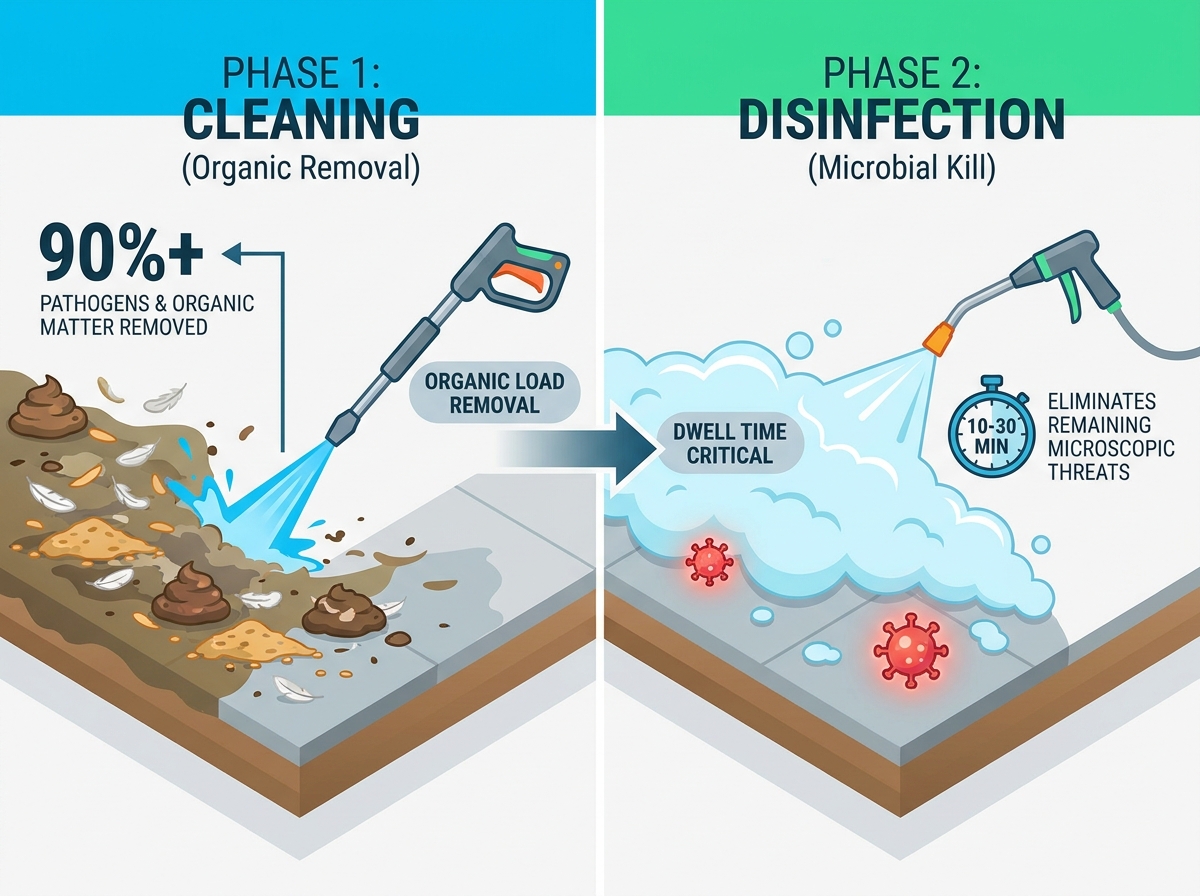
Every effective turnaround begins with comprehensive organic load removal. You cannot skip or rush this foundational phase.
First, you must master dry cleaning fundamentals. Systematic removal initiates the entire process. You take out all live birds, residual litter, and mobile equipment. Next, teams must adopt a strict "top-down" approach. Workers blow or brush dust heavily from ceilings and light fixtures. They clean ventilation shafts carefully using long-reach tools. This top-down sequence prevents falling debris from re-contaminating lower surfaces later. You want the floors swept entirely clean of major physical debris before introducing water.
Once dry cleaning concludes, wet cleaning and degreasing operations begin. Barn surfaces accumulate stubborn layers of fats and proteins over a flock's lifecycle. You need heavy-duty alkaline detergents to break these down. These specialized soaps penetrate tough biofilms highly effectively. Application technique matters immensely during this stage. We recommend high-pressure, low-volume washing techniques. This specific method lifts organic matter cleanly away from structural materials. It avoids driving dangerous pathogens deeper into microscopic barn crevices.
Finally, you must enforce a strict drying requirement. Many farm managers skip this crucial step to save turnaround time. Do not make this costly mistake. Applying chemicals to wet surfaces dilutes their active concentrations immediately. This drops the chemical strength far below its efficacious threshold. The barn interior must dry completely before you move to the next phase. Large industrial fans and supplemental heaters often accelerate this necessary drying period.
Selecting the right chemicals directly dictates your biosecurity success. You must evaluate various poultry farm disinfectants carefully before purchasing bulk quantities. A chemical suited for one farm might fail completely on another.
Always assess products based on broad-spectrum pathogen efficacy. Consider their tolerance to residual organic matter carefully. Check their compatibility against your local water hardness levels. Hard water minerals frequently neutralize certain sensitive chemical profiles. Note their temperature stability during application, especially in winter months. You must also differentiate chemical categories clearly. Continuous-use water line treatments serve a vastly different purpose than terminal turnaround chemicals.
Oxidizing agents offer exceptional viral efficacy for large-scale operations. For terminal cleaning, a potassium peroxymonosulfate disinfectant provides specific operational advantages. It delivers rapid oxidation action upon physical contact. This unique chemistry shows documented efficacy against highly pathogenic avian influenza (HPAI). Furthermore, it boasts a superior safety profile for sensitive barn equipment. It degrades naturally without causing heavy corrosive damage to expensive metal fixtures.
You might also consider aldehydes and phenols for specific challenges. These alternative classes offer distinct pros and cons. They maintain strong residual activity long after application. They remain highly effective even in high organic load conditions. However, they present significant occupational hazards for your staff. Workers face much higher toxicity risks during indoor application. You must enforce stringent personal protective equipment (PPE) protocols when utilizing them. Respiratory protection becomes absolutely mandatory.
Table: Comparison of Common Chemical Classes for Terminal Turnarounds
Chemical Class | Primary Advantages | Common Limitations | Equipment Corrosivity |
|---|---|---|---|
Oxidizing Agents | Rapid kill time, excellent viral efficacy | Inactivated by heavy organic debris | Low to Moderate |
Aldehydes | High efficacy in organic matter | Strict worker safety hazards, toxic fumes | Low |
Phenols | Good residual activity on surfaces | Environmental persistence, odor retention | Moderate |
Even premium chemicals fail under poor physical application methods. The harsh implementation reality involves proper dwell time. A sanitizer only destroys pathogens while it remains wet. If a product dries before reaching its required contact time, hardy pathogens survive. Most EPA and manufacturer labels dictate 10 to 30 minutes of continuous wet contact. Achieving this benchmark requires strategic equipment choices.
Tackling vertical walls and ceilings presents a unique physics challenge. Gravity pulls liquid sprays down to the floor rapidly. To counteract this constant pull, you must use a foaming agent for disinfectant applications. Foam fundamentally changes how the chemical behaves physically. It adheres thickly to steep ceilings, sheer walls, and complex equipment profiles. This creates a highly visible white layer. Workers can easily track their coverage progress visually. More importantly, dense foam prevents premature evaporation. It stops wasteful chemical runoff from pooling on the floor. This ensures the active ingredients keep working aggressively against surface microbes.
After direct surface application, some farms utilize secondary fumigation and fogging. You should always treat these as supplementary steps. Thermal fogging addresses airborne particulates efficiently. It reaches inaccessible crevices high up in the rafters. However, fogging never replaces direct surface soaking. It lacks the sheer liquid volume and mechanical action needed to penetrate floor biofilms. Use fogging only as a final, airborne polishing step before locking the barn.
Once washing and chemical application conclude, the barn enters its mandatory rest period. Downtime acts as a vital, biological kill step. An empty, completely dry facility provides a hostile environment for lingering microbes. Desiccation actively starves surviving pathogens of necessary moisture. This natural barrier requires management patience. A standard commercial downtime typically lasts between 7 and 14 days. You should restrict all non-essential foot traffic during this waiting phase.
Before restocking new birds, you must conduct objective evaluation and testing. Visual inspections simply do not detect microscopic viral threats. We strongly recommend implementing specific diagnostic tools:
ATP (Adenosine Triphosphate) swabbing to detect residual organic cellular matter.
Targeted microbial culturing to identify specific surviving bacterial strains.
Salmonella drag swabs across floor surfaces to ensure compliance.
Water line sampling to confirm biofilm eradication inside drinking systems.
You must also complete crucial shortlisting and action items for future turnarounds. Build a structured, actionable checklist for your local management team. Consider these essential procedural steps:
Review your local water quality parameters, including pH and hardness, before purchasing bulk chemicals.
Establish a site-specific protocol tailored to your unique barn dimensions and equipment type.
Dictate exactly who holds ultimate responsibility for each specific phase of the turnaround checklist.
Schedule routine internal audits to review chemical usage logs and exact contact time records.
Establish a clear quarantine zone around the recently disinfected barn to prevent cross-contamination.
A successful poultry farm turnaround demands strict sequential discipline. You must dry clean, wet wash, completely dry, strategically disinfect, and finally rest the facility. Cutting corners during any single phase jeopardizes the entire flock cycle. Overlapping these distinct steps guarantees costly biosecurity failures.
Investing in appropriate application methods and validated chemical profiles pays immense dividends. These practices directly safeguard your long-term farm profitability. They also strengthen your vital integrator relationships by ensuring consistent flock yields. To maintain high biosecurity standards moving forward, consider these immediate next steps:
Audit your current cleaning supplies to ensure strict compatibility with your local water chemistry.
Train your application crew specifically on proper foam generation techniques for vertical surfaces.
Integrate environmental swab testing into your mandatory pre-restocking clearance process.
Designate a dedicated biosecurity officer to oversee turnaround compliance documentation meticulously.
By embracing this structured approach, you turn vulnerable downtimes into robust defensive shields for your operation.
A: No. Mixing chemicals safely requires advanced chemistry knowledge. Combining different products (such as chlorine solutions with strong acids) often neutralizes their active ingredients. Worse, this mistake can create lethal toxic gases inside enclosed barns. Always apply a single, validated product exactly according to the manufacturer's label instructions.
A: High-pressure sprayers apply liquid solutions that quickly run off vertical walls and slick ceilings. Foaming agents fundamentally alter the fluid dynamics. They trap the active chemical firmly against the surface. This ensures the sanitizer remains wet for the necessary 10 to 30-minute pathogen kill time required by EPA standards.
A: While complete pathogen resistance remains relatively rare, rotating between chemical classes proves highly beneficial. Moving from an oxidizing agent to an aldehyde complex every few flock cycles represents a strong best practice. This rotation prevents the gradual buildup of highly tolerant bacterial strains and stubborn protective biofilms on barn surfaces.


