
English


Views: 0 Author: Site Editor Publish Time: 2026-10-08 Origin: Site


Outbreak prevention in agricultural facilities requires strict biosecurity protocols. Choosing the right chemical agent dictates the success of your infection control strategy. Farm managers frequently face a complex decision during barn preparation. You must choose between rapid-acting oxidative agents and highly stable chemical blends. You have to balance pathogen kill rates against daily operational realities. These real-world realities include heavy organic load, freezing temperatures, and vital worker safety. Standard cleaning routines often fall short without the correct chemical application.
This guide evaluates two of the most relied-upon farm disinfectants available today. We will analyze oxidizing powders alongside aldehyde-quaternary ammonium blends. You will learn exactly how these distinct chemicals work in demanding field conditions. We provide an objective framework to help you select the right chemistry for specific livestock environments. By the end of this guide, you will understand how to deploy these essential biosecurity tools effectively.
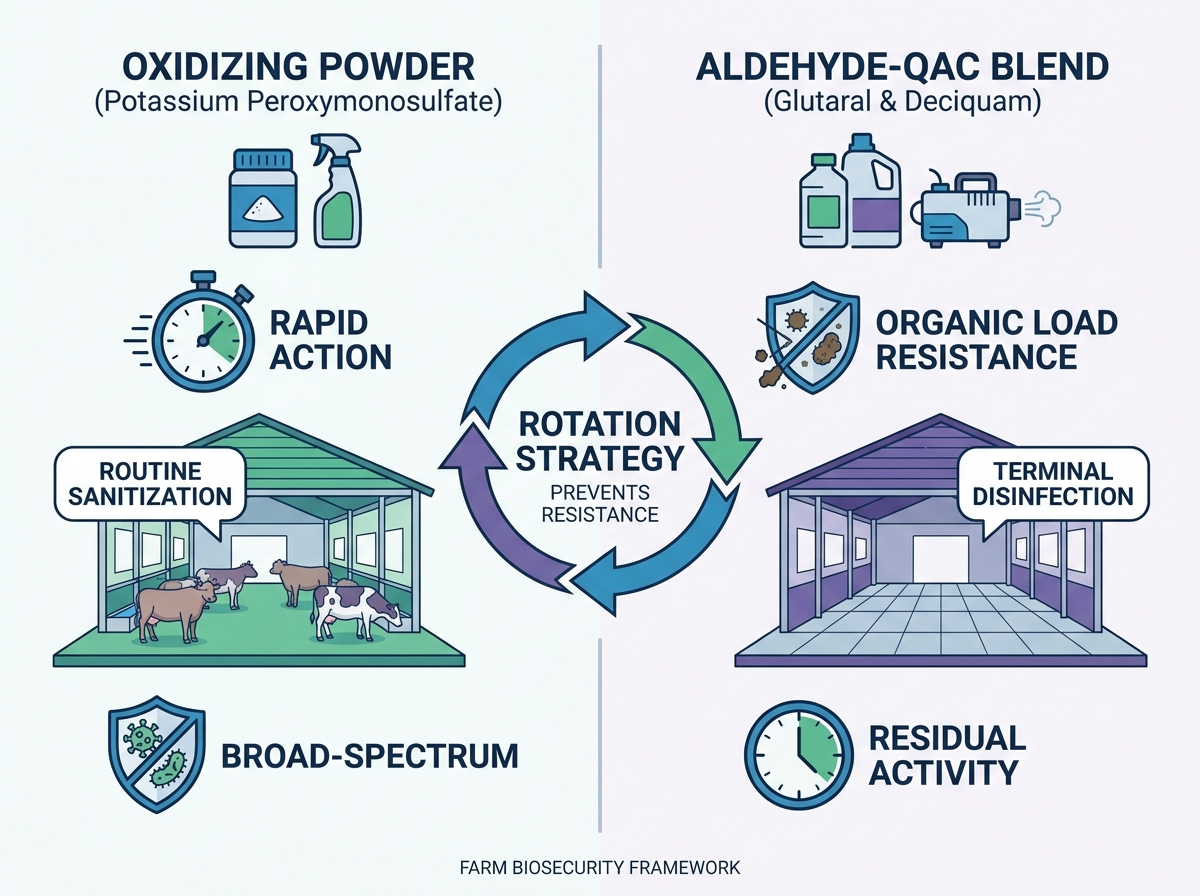
Compound potassium peroxymonosulfate powder excels in rapid, broad-spectrum virucidal action (e.g., against Newcastle disease) and is safer for use in occupied animal housing.
Glutaral and Deciquam Solution offers superior stability in the presence of heavy organic matter and provides residual antimicrobial activity.
Selection depends on the operational stage: Oxidizers are ideal for routine, high-turnover sanitization, whereas Glutaral-QACs are better suited for deep terminal disinfection of empty barns.
Rotation is critical: Alternating between these two chemical classes prevents pathogen resistance and preserves long-term biosecurity effectiveness.
Standard disinfection protocols often fail in busy agricultural settings. This failure usually stems from three very common operational errors. Workers face strict time constraints during barn turnovers. They might rush the critical preparation phases resulting in inadequate initial cleaning. Workers sometimes use incorrect dilution ratios when mixing concentrates. Chemical deactivation also occurs rapidly when you apply products incorrectly to wet surfaces. True biosecurity requires you to understand these basic pitfalls before selecting any product.
You must evaluate your options based on strict success metrics. Consider these three foundational criteria for optimal performance:
Broad-Spectrum Efficacy: Your chosen product must deliver proven kill rates consistently. It needs to destroy tough, non-enveloped viruses and resilient bacterial spores upon contact.
Organic Load Resistance: Barns and sheds remain inherently messy environments. The chemical must function effectively when feces, blood, or feed residue remain on surfaces.
Operational Viability: Practical daily application matters immensely to farmhands. You should assess the ease of storage, safe mixing, and broad facility application. The product must also perform reliably across varying seasonal temperatures.
Meeting these criteria ensures a robust defense against agricultural pathogens. You protect your livestock inventory by establishing this strong chemical baseline. Consistent application ultimately shields your entire supply chain from devastating disease outbreaks.
This widely used chemical agent relies on a highly powerful oxidative mechanism. When dissolved in water, it produces highly reactive oxygen species immediately. This intense oxidative action physically destroys pathogen cell walls. It also denatures delicate viral structures rapidly. The resulting chain reaction neutralizes immediate biological threats across treated zones.
The primary advantages of compound potassium peroxymonosulfate powder center on speed and handling safety. You achieve an extremely fast contact time for virucidal efficacy. This incredible speed makes it ideal for high-traffic transition areas. It is also environmentally degradable after application. The formula breaks down into harmless byproducts naturally over a short time. Furthermore, it boasts a remarkably high safety profile for daily use. Authorities often approve this specific powder for aerial spraying protocols. You can frequently use it safely near occupied livestock housing without stressing animals.
However, you must consider its implementation limitations and potential risks carefully. Aqueous solutions possess a relatively short shelf life. Mixed solutions typically expire five to seven days after preparation. You will also see efficacy drop significantly if heavy, uncleaned organic matter remains. Blood and manure rapidly deplete its oxidative power before it reaches the pathogen. Finally, improper dilution can make the concentrated solution corrosive to soft metals. Always follow precise manufacturer guidelines to protect your expensive farming equipment.
This formula leverages a potent dual-action chemical mechanism for heavy-duty cleaning. Deciquam functions as a highly effective quaternary ammonium compound. It acts as a surfactant cutting straight through heavy agricultural grime and fats. This vital cleaning action clears the necessary path for the second active ingredient. Glutaraldehyde then enters to cross-link and paralyze critical pathogen proteins. This synergistic effect creates a formidable microbial barrier on farm surfaces.
You gain several primary advantages using Glutaral and Deciquam Solution. It maintains exceptionally high efficacy in severely dirty conditions. High organic load tolerance makes it perfect for heavily soiled environments like farrowing crates. It remains highly stable in both concentrate and diluted forms. You can rely on its strong performance during harsh cold weather applications. Additionally, it leaves a residual active layer on surfaces post-application. This lingering chemical activity extends your biosecurity protection window considerably.
Despite these clear benefits, this chemistry carries specific implementation limitations and risks. It requires noticeably longer contact times compared to rapid oxidizers. You must also manage serious occupational health hazards strictly. Respiratory and dermal toxicity are genuine concerns here for your workforce. Application requires strict personal protective equipment (PPE) for every worker. You must keep facilities entirely vacant during the whole disinfection and venting process.
Comparing these chemical agents helps you make highly informed management choices. Your specific farm environment dictates which solution performs best.
Different chemical profiles target specific disease threats uniquely well. Oxidative powders perform exceptionally well against Avian Influenza in poultry operations. Their incredibly fast action halts rapid viral spread effectively. Conversely, Glutaraldehyde blends often handle African Swine Fever (ASF) in swine units better. Their ability to cut through lingering organic matter guarantees thorough eradication in pens. You must align the chemical precisely to your primary pathogenic threat.
Surface porosity drastically changes how these chemicals perform in reality. Oxidizers work beautifully on non-porous surfaces like steel metal and smooth plastic. They cover slick areas rapidly and break down quickly afterwards. Glutaraldehyde blends penetrate rough porous surfaces far better. They bind effectively to untreated wood and cracked concrete floors. Temperature also plays a crucial role in your choice. Glutaral-QACs perform consistently in freezing cold outdoor sheds. Conversely, you may require much warmer water to properly dissolve potassium peroxymonosulfate powders.
Regulatory considerations heavily influence your daily application protocols. Oxidizers feature minimal restricted entry intervals (REI). You can often re-enter treated areas almost immediately after the mist settles. Glutaraldehyde blends mandate strict ventilation protocols before humans or animals return. The REI is much longer due to serious respiratory hazards. You must train your farm staff thoroughly on these safety requirements before any use.
Operational Characteristics Comparison Chart
Characteristic | Potassium Peroxymonosulfate | Glutaral-QAC Blends |
|---|---|---|
Primary Mechanism | Oxidation of cell walls | Protein cross-linking & surfactant action |
Contact Time Required | Very Fast (typically 5-10 minutes) | Moderate to Long (typically 20-30 minutes) |
Organic Load Tolerance | Low to Moderate | High |
Cold Weather Stability | Reduced dissolution speed | Excellent stability |
Worker Safety Profile | High (occupied areas often permitted) | Low (strict PPE & vacant facilities required) |
You achieve maximum biosecurity protection by matching the chemical to the specific operational scenario. Smart deployment reduces systemic disease risk significantly.
Here are highly practical scenario-based recommendations:
Choose Potassium Peroxymonosulfate when: You are disinfecting transport vehicles at entry gates. It is absolutely perfect for replenishing daily boot dips. Use it for flushing drinking water lines safely. Rely on it for routine sanitization when animals remain nearby.
Choose Glutaral-QAC when: You are conducting deep terminal cleanouts between animal production cycles. It excels at disinfecting heavily soiled pen equipment. Rely on it heavily when preparing cold-weather facilities for entirely new flocks or herds.
Implementing a strict rotation strategy is critical for long-term farm success. You must build a comprehensive biosecurity calendar to manage this rotation effectively. Alternate between compound potassium peroxymonosulfate powder and Glutaral and Deciquam Solution regularly. Switch product classes every few months or between major production cycles. This standard practice actively prevents dangerous microbial resistance from taking hold.
Follow these standardized rollout steps to ensure total success:
Dry Cleaning: Remove all bulk organic matter, dry manure, and leftover feed manually using shovels and brooms.
Washing: Apply a dedicated foaming detergent to break down stubborn, sticky biofilms on floors and walls.
Drying: Allow all surfaces to dry completely to prevent diluting the final chemical application.
Application: Apply your chosen chemical at the precise recommended concentration using calibrated sprayers.
Contact Time: Let the chemical solution sit entirely undisturbed for the exact manufacturer-specified duration.
No single chemical offers a universal silver bullet for agricultural biosecurity. Effective infection control relies entirely on matching a product’s specific chemical properties to your unique environmental challenges. You must fully understand how ambient temperature, surface type, and organic load impact chemical performance.
Audit your facility's specific physical constraints carefully before making a bulk purchase. Evaluate your average barn turnover speed and worker safety capabilities objectively. Select the right initial product based on this comprehensive facility audit. Finally, implement a highly strategic rotation of both chemical classes. This proactive approach ensures comprehensive, long-term pathogen control across your entire farming operation.
A: No. Mixing oxidizers with aldehydes/QACs can cause dangerous chemical reactions, release toxic gases, and neutralize the efficacy of both products. Always rinse surfaces thoroughly if switching between them.
A: Industry best practice suggests rotating disinfectant classes (e.g., from an oxidizer to a Glutaral-QAC blend) every few months or between major production cycles to prevent resistant pathogen strains.
A: Compound potassium peroxymonosulfate powder is typically preferred for boot baths due to its rapid kill time. However, it must be replenished frequently, especially when heavily soiled with mud or manure.
A: It is highly stable in cold environments, but like all liquid disinfectants, its efficacy slows as temperatures drop. Addition of approved antifreeze agents (like propylene glycol) may be required in sub-zero conditions.


