
English


Views: 0 Author: Site Editor Publish Time: 2026-10-22 Origin: Site


The 15-to-17-week pullet transfer window acts as the most critical vulnerability point in layer farm management. Relocating thousands of birds between specialized rearing and laying facilities requires flawless execution. Every operational step must preserve their lifelong productivity. Inheriting a flock lacking documented or poorly executed vaccination protocols introduces severe biological risks. These oversights also create massive financial liabilities for the upcoming laying cycle.
Managers who accept incomplete records operate blindly. They turn expensive pullets into potential vectors for disease outbreaks. This article provides farm managers and production integrators with a rigorous framework. You will learn how to audit transfer documentation thoroughly. We will show you how to verify flock immunity, standardize intake protocols, and protect your baseline from preventable disasters. Following these practices ensures a seamless, highly productive flock handover.
Comprehensive handover documentation must include specific vaccine strains, administration routes, and lot numbers, not just administration dates.
Baseline serology reports are non-negotiable for verifying that the rearing farm’s protocol successfully generated protective immunity.
Transitioning from manual paper logs to standardized digital records reduces data silos and prevents compliance gaps during veterinary audits.
Identifying documentation gaps at transfer dictates the necessity for immediate post-transfer boosters or targeted biological interventions.
Accepting a flock without verifiable immunological data turns the layer house into a high-risk environment. Disease threats constantly surround commercial poultry facilities. Outbreaks of Newcastle Disease (ND), Infectious Bronchitis (IB), or Salmonella can quickly devastate peak egg production. You cannot simply hope the rearing farm did their job. You must demand absolute proof of protection.
A successful handover requires complete transparency. Farm managers must achieve 100% alignment across three crucial areas. First, the rearing farm’s invoice must match the delivery. Second, the physical flock profile must reflect expected growth metrics. Third, the immunological paperwork must validate the promised health status. Any discrepancy between these three pillars signals immediate operational danger.
Operating a blind intake process guarantees eventual revenue loss. Translating missing data into real-world consequences helps clarify the financial stakes. Consider these common profit-killers caused by poor transfer documentation:
Unexpected Mortality Spikes: Pullets lacking adequate protection often succumb to early lay stress. Missing booster records leave managers unprepared for sudden die-offs.
Egg Drop Syndrome: Unprotected flocks remain highly susceptible to viral challenges mid-lay. These challenges cause severe, irreversible drops in daily egg production.
Downgraded Egg Quality: Diseases like IB permanently damage the oviduct. You will see thin shells, watery albumen, and unmarketable eggs.
Regulatory Fines: Incomplete Salmonella paperwork can trigger devastating regulatory actions. You risk complete product recalls and brand destruction.
Standard farm operations must move beyond outdated record-keeping methods. Fragmented PDFs and informal social media templates no longer suffice. Relying on paper logs increases the likelihood of human error. Modern layer operations require structured, auditable data systems. Digital records ensure rapid retrieval during veterinary inspections. They also allow production integrators to spot regional disease trends before they impact the bottom line.
Relying solely on administration logs presents a massive blind spot. A logbook only proves a worker administered a product. It never proves the bird actually absorbed it. You must evaluate comprehensive serology reports. These laboratory results confirm the successful development of poultry vaccines and antibodies. Serology acts as the ultimate truth teller in flock management.
Titer uniformity represents a critical metric during your evaluation. Assess the Coefficient of Variation (CV) in the titer levels across the flock. The CV measures the spread of antibody responses. High variability indicates poor application technique at the pullet farm. It leaves significant subpopulations completely vulnerable to field viruses. A low CV proves uniform application and reliable flock-wide immunity.
Auditing the sequence of live versus inactivated vaccines requires strict attention to detail. Farm managers must verify the precise timing of live primers. These primers must adequately prepare the bird's immune system. Workers must then follow up with inactivated (killed) vaccines before transfer. This specific sequence ensures maximum antibody duration throughout the entire lay period. Missing a live primer renders the expensive inactivated shot largely useless.
Use these antibody baselines to enforce vendor accountability. The rearing farm or pullet supplier signed a rearing contract. They promised to deliver biologically secure birds. If serology reports show insufficient titers, the vendor failed their obligation. You can use this data to negotiate compensation. More importantly, it forces the supplier to improve their application procedures for future batches.
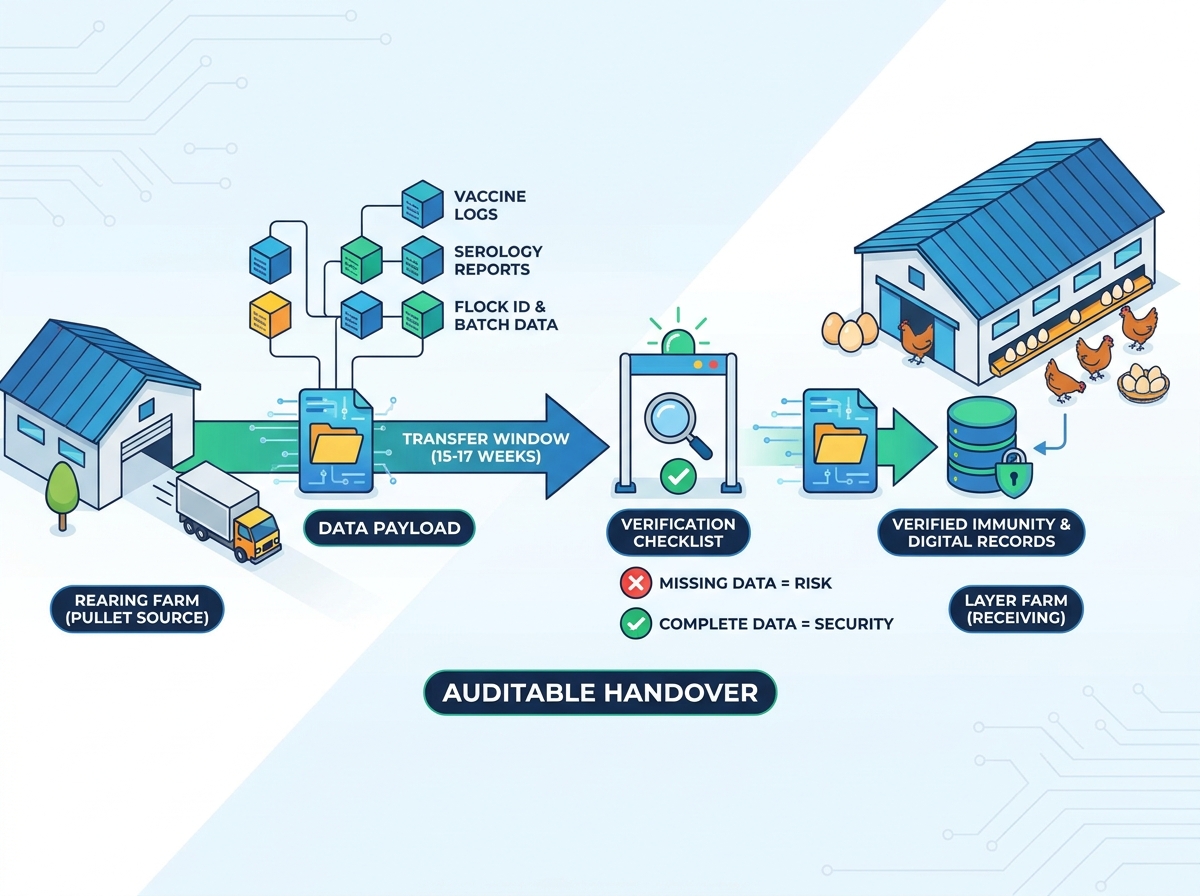
A rigorous handover checklist prevents biological assumptions. Every pullet transfer demands a structured review of incoming paperwork. Never accept a flock until the transport driver hands over the complete dossier. Intake managers must review three distinct categories of documentation before unloading begins.
First, verify all flock identity and batch logs. You need the exact hatch date and the specific genetic strain. Confirm the exact transfer date to calculate the physiological age precisely. Cross-reference the corresponding flock ID codes carefully. These codes must seamlessly match the rearing house records to the designated layer house placement. Mixing up batch identities destroys traceability.
Second, scrutinize the detailed administration data. Demand specific dates of administration. Plot these dates against the chronological age of the bird in weeks and days. You must also record the administration methods applied. Methods include drinking water, coarse spray, wing-web stab, or intramuscular injection. Each method carries different efficacy rates and potential failure points.
Third, enforce absolute product and manufacturer transparency. Generic names do not provide enough context. You need exact vaccine names and manufacturer details. Record all lot numbers, batch numbers, and expiry dates. Additionally, demand a record of any adverse reactions. The rearing farm must disclose any post-vaccination mortality spikes observed during the growth phase.
Documentation Category | Specific Data Points Required | Why You Need It |
|---|---|---|
Flock Identity | Hatch date, strain, flock ID codes | Ensures precise age calculation and full traceability. |
Administration Timeline | Exact dates mapped to bird age (weeks/days) | Verifies proper spacing between live and killed doses. |
Application Methods | Spray, water, wing-web, injection | Highlights potential application failure risks. |
Product Transparency | Manufacturer, lot number, expiry date | Crucial for vendor accountability and recall management. |
Adverse Events | Reaction severity, mortality spikes | Prepares the layer house for long-term health complications. |
Receiving the flock marks the beginning of active immunity management. Evaluating the inherited pullet program requires immediate attention. You must assess how well this incoming protection aligns with endemic disease pressures. The receiving layer farm occupies a specific geographic region. This region carries unique viral and bacterial threats. An excellent rearing program in one state might fail completely in another.
Perform a thorough gap analysis on the incoming records. Identify any missing coverage during the rearing phase. This analysis directly informs your decisions regarding choosing a poultry vaccine program for the active laying cycle. If the rearing farm skipped a crucial variant of Infectious Bronchitis, you must act. You will need to schedule targeted mid-lay boosters to close this immunity gap.
However, you must balance immediate interventions against physiological stress. Transporting birds creates massive physiological fatigue. Acclimatizing to the new layer house equipment adds further strain. Administering aggressive boosters immediately upon arrival often suppresses their immune system further. Balance the need for rapid protection against the necessity of stress mitigation. Give the flock adequate time to find water lines and adjust to new lighting schedules before initiating further interventions.
Managing transfer data poorly introduces massive operational risks. Keeping transfer records in isolated spreadsheets creates dangerous data silos. When staff members leave, they often take specialized knowledge with them. Best practices dictate migrating all historical pullet data immediately. Move it directly into the central layer farm management software. This ensures universal access for farm managers and veterinary consultants alike.
Compliance drives the modern poultry industry. Handover records must meet the strict standards required for third-party quality assurance audits. Food safety compliance remains completely non-negotiable. Missing Salmonella vaccination records can shut down your entire packing operation. Integrator requirements often demand specific digital formats for approval. Falling behind on paperwork puts your vendor contracts in serious jeopardy.
Farm managers must establish clear escalation protocols. You need predefined thresholds for when discrepancies demand expert intervention. If transfer paperwork contains obvious alterations, stop the intake process. If physical flock uniformity falls below 80%, sound the alarm. These scenarios require escalating to professional poultry health technical support. Bring in veterinary experts for immediate farm-level auditing to assess the true risk before moving forward.
Successfully managing the pullet transfer window secures the profitability of the entire lay cycle. You must standardize your intake checklist across all farm locations. Train your intake managers extensively on paperwork verification and discrepancy identification. Digitize all incoming records immediately upon flock arrival to prevent data loss. Never let a transport truck leave your facility until all documents satisfy your stringent requirements.
Treat the pullet handover as a critical data acquisition event. It involves much more than the mere physical transfer of birds. The biological intelligence you gather today dictates the financial yield of your flock tomorrow. Demand transparency, verify immunity, and act swiftly on any identified gaps.
A: The Coefficient of Variation (CV) measures titer variability. An excellent flock displays a CV below 40% for most standard viral vaccines. A CV exceeding 60% indicates poor application uniformity. High variability means too many birds lack protective antibodies, requiring immediate veterinary review.
A: Layer farms should retain all transfer and vaccination records for a minimum of three years post-depletion. Regulatory bodies, food safety auditors, and legal compliance teams frequently require historical traceability. Storing these records digitally ensures quick retrieval during unannounced inspections.
A: Halt the unloading process immediately. Quarantine the incoming birds in a designated holding zone if possible. Contact the rearing farm manager to investigate loading errors or mixed batches. Never mix an unverified batch into your main layer house until full traceability is restored.
A: Rarely. Aggressive boosting during the lay cycle often triggers severe production drops. Furthermore, adult birds cannot properly prime their immune system if they missed essential live vaccines during the rearing phase. You cannot easily replace foundational pullet immunity.


