
English


Views: 0 Author: Site Editor Publish Time: 2026-08-15 Origin: Site


Goose parvovirus (GPV), commonly known as gosling plague, is highly infectious among goslings and ducklings, driving catastrophic mortality rates that often exceed 90% in unprotected flocks under four weeks of age. Flock managers and commercial waterfowl producers face a critical timing dilemma: achieving long-term herd immunity and preventing overt disease without leaving newly hatched, highly susceptible birds exposed during the immunity lag phase. Mitigating GPV requires a bifurcated approach. This guide breaks down the technical evaluation, deployment criteria, and implementation realities of using active vaccination protocols versus deploying passive Goose Parvovirus Antibodies for immediate emergency support. We will examine how to navigate maternal antibody interference, establish effective breeder flock vaccination strategies, and secure reliable supply chains to protect your waterfowl operations from sudden outbreaks.
Active vs. Passive Deployment: Vaccines build long-term active immunity to reduce the incidence and severity of disease, but require weeks to reach protective titer levels; antibodies deliver immediate, short-term passive immunity critical for active outbreaks.
Maternal Interference is the Primary Bottleneck: High levels of maternal antibodies in day-old birds will neutralize early live vaccination attempts, necessitating precise titer monitoring or the use of novel vaccine technologies.
Strategic Breeder Vaccination: The most cost-effective prevention model relies on hyper-immunizing breeder flocks (using live or inactivated vaccines) to pass protective maternal antibodies to progeny, reserving direct antibody administration for emergency containment.
Supplier Viability Dictates Success: The efficacy of both interventions relies entirely on cold-chain integrity, strain relevance, and rigorous manufacturing standards, requiring strict vetting of any duck vaccines and antibodies supplier.
Understanding the pathogenesis of GPV is the baseline for formulating an effective defense on the farm. The virus specifically targets the rapidly dividing cells in the intestinal tract, heart, and liver of young waterfowl. Transmission occurs swiftly through direct fecal-oral contact and contaminated environmental vectors like boots, equipment, and shared water troughs. The virus exhibits extreme environmental persistence. It survives in soil, water, and dried feces for months while resisting many common agricultural disinfectants, including standard quaternary ammonia compounds. Birds under 30 days old face a narrow window of extreme vulnerability. Once infected, goslings and ducklings exhibit severe fibrinous enteritis, lethargy, anorexia, and rapid death, often within 48 to 72 hours of initial exposure.
When performing a field necropsy on a 12-day-old gosling suspected of GPV, you will typically find a severely inflamed intestinal tract. The hallmark sign is a solid, yellowish-white fibrinous cast blocking the lower intestine. The liver often appears enlarged and congested, while the heart muscle may show pale streaks indicative of myocarditis. Recognizing these lesions early allows you to trigger an emergency response before the rest of the barn succumbs.
Successful GPV management requires achieving specific operational metrics. You must track these indicators across every production cycle:
Prevention of overt clinical disease entirely in early-stage birds under 30 days of age.
Reduction of acute mortality to below 2% during the critical brooding phase.
Maintenance of stable, high titer levels in breeder flocks to ensure consistent protection for progeny across multiple hatching cycles.
Minimization of secondary bacterial infections, which indicates a robust overall immune profile within the flock and reduces the need for extensive antibiotic interventions.
Pre-existing maternal antibodies present a significant biological hurdle in waterfowl immunology. When hyper-immunized breeders pass immunity to their progeny via the egg yolk, the hatchling absorbs these circulating antibodies into its bloodstream during the first few days of life. While this provides essential early protection, these same antibodies bind to and neutralize the antigens introduced by early live vaccination attempts. This biological mechanism renders early live vaccination completely ineffective. It creates a dangerous gap in protection where maternal immunity wanes before the bird's active immune system can mount a response to a delayed vaccine.
When an outbreak strikes a barn or when vulnerable day-old birds lack maternal protection due to breeder flock issues, active vaccines act too slowly. Hyperimmune sera and purified antibodies offer a direct method of bypassing the bird's developing immune system. They provide immediate, circulating viral neutralization. This passive immunity acts instantly to bind the virus upon entry, preventing it from attaching to host cells and replicating within the intestinal tract.
You must deploy these antibodies prophylactically in day-old goslings and ducklings hatched from unvaccinated or low-titer breeder flocks. They also serve as a critical emergency ring-treatment during active outbreaks. Administering antibodies to asymptomatic birds surrounding an infection epicenter suppresses viral shedding and drastically reduces acute mortality across the facility. Time is the critical factor. Administering antibodies at the first sign of lethargy or feed refusal in a flock can save thousands of birds. The standard field protocol involves a 0.5ml to 1.0ml subcutaneous injection in the dorsal neck, using an 18-gauge or 20-gauge needle to handle the viscosity of the serum.
The half-life of injected antibodies is relatively short. Protection remains transient, typically lasting between 7 and 14 days depending on the initial dose and the bird's metabolic rate. You must implement strict biosecurity protocols to prevent reinfection once these circulating antibody levels naturally wane. Passive immunity does not create memory B or T cells. Once the antibodies degrade, the bird returns to a fully susceptible state unless active vaccination follows.
Large-scale administration presents logistical challenges and requires significant manual labor, as each bird requires individual handling and injection. Improperly filtered serum carries a risk of serum-borne contamination or adverse reactions. You must pair antibody administration with targeted broad-spectrum antibiotics in the drinking water. This combination reduces losses from secondary bacterial infections, such as E. coli or Salmonella, which frequently exploit the temporary immunosuppression caused by a primary viral challenge.
Deployment Scenarios for Passive Immunity
Deployment Strategy | Target Flock Age | Primary Objective | Expected Duration of Efficacy |
|---|---|---|---|
Prophylactic Injection | Day 1 to Day 3 | Protect hatchlings lacking maternal antibodies | 10 to 14 Days |
Emergency Ring-Vaccination | Any age under 4 weeks | Halt viral shedding in an active outbreak zone | 7 to 10 Days |
Therapeutic Treatment | Symptomatic birds | Reduce acute mortality and tissue damage | Variable based on infection severity |
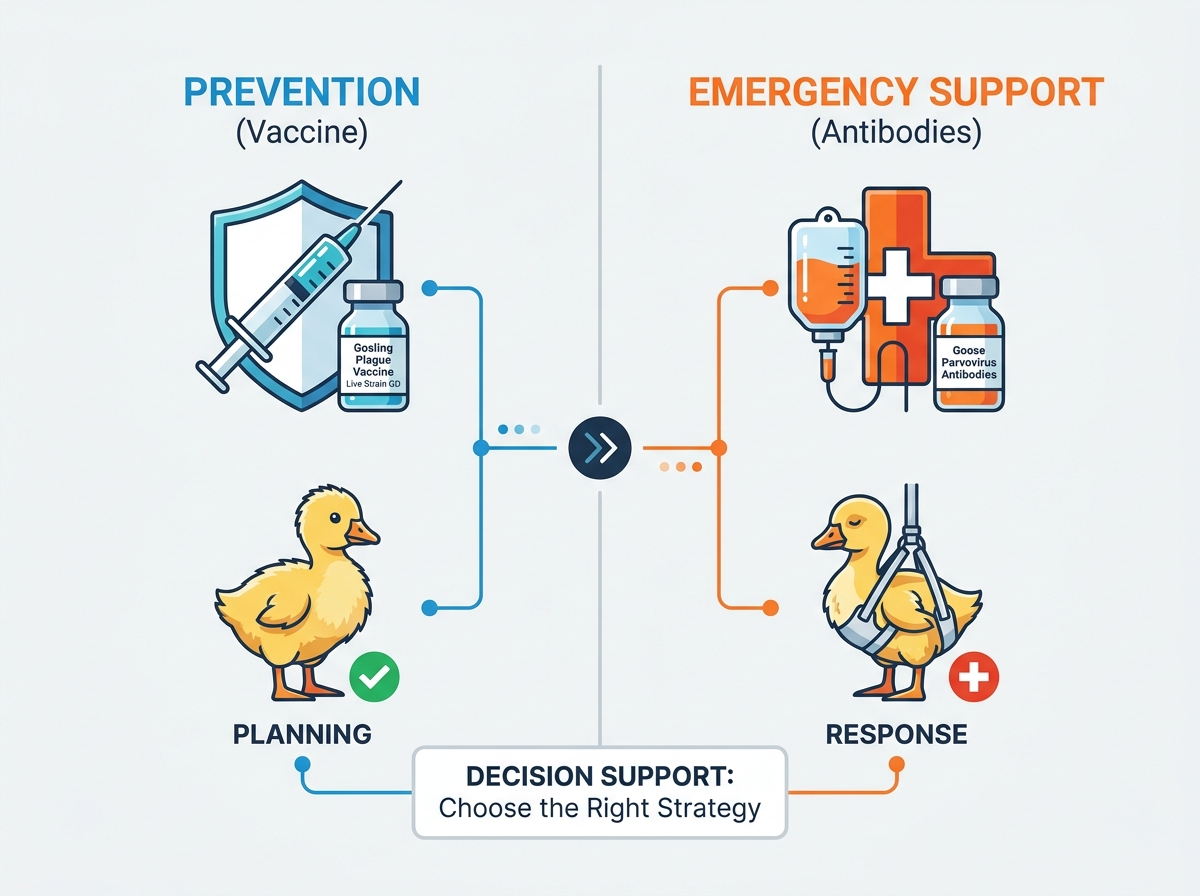
For long-term disease control, active immunization remains the cornerstone of waterfowl health. Formulations like the Gosling Plague Vaccine Live Strain GD stimulate robust cellular and humoral immunity. Attenuated live strains replicate safely within the host, triggering a comprehensive and long-lasting immune response without causing clinical disease. This active immunity generates memory cells, preparing the bird to fight off future field virus exposures independently.
Vaccinating adult breeders prior to the laying cycle offers immense immunological advantages. Live attenuated strains effectively prime the immune system. Inactivated vaccines then serve as powerful boosters prior to egg production. This prime-boost combination ensures uniform, high-level maternal antibody transfer to the yolk, protecting the next generation during their most vulnerable weeks. A well-executed breeder program drastically reduces the need for manual interventions in the hatchery.
Executing an active vaccination program requires precision in scheduling and delivery. You must follow strict protocols to ensure efficacy:
Establish a clear immunization schedule for primary and booster doses in replacement stock at least four weeks before the breeding season begins.
Conduct laboratory titer determination using Hemagglutination Inhibition (HI) testing. This identifies the exact window when maternal antibodies decline enough to permit the safe and effective vaccination of young birds.
Draw blood samples from a representative subset of day-old hatchlings using a 25-gauge needle from the jugular vein to establish a baseline titer.
Evaluate subcutaneous or intramuscular injection protocols carefully. Mass administration methods via drinking water often fail to deliver uniform dosing for GPV, requiring individualized handling for optimal efficacy.
Mix live vaccines meticulously. Draw chilled, sterile diluent into a syringe, inject it into the glass vial containing the freeze-dried pellet, and swirl gently. Never shake the vial, as aggressive agitation shears the viral envelopes.
Administer the reconstituted live vaccine within two hours of mixing. Keep the bottle in a cooler on ice while walking the barn to prevent titer degradation.
Researchers are continuously developing novel chimeric ND-GP virus-like particles (cVLPs). This modern alternative bypasses maternal antibody interference in early-stage goslings. By utilizing a different viral vector that lacks the GPV genome but displays the capsid proteins, cVLPs stimulate cellular immunity even in the presence of high maternal GPV antibodies. This offers a technological bridge over the traditional immunity gap, allowing for earlier active vaccination without neutralization.
Live vaccines carry a slight risk of vaccine-induced reactions in stressed or immunocompromised birds. They also demand uncompromising cold-chain requirements. Any temperature deviation during transport or storage degrades the live virus, rendering the vaccine completely useless and leaving the flock unprotected. You must monitor storage refrigerators daily and calibrate thermometers monthly.
GPV rarely operates in isolation. It frequently co-circulates with other severe pathogens in mixed waterfowl operations, including duck viral enteritis and Pasteurella multocida. Managing a multi-disease environment requires comprehensive, synchronized planning. You cannot treat GPV prevention as a standalone task; it must fit seamlessly into the broader flock health program.
You must stagger GPV interventions with other critical immunizations. For example, scheduling a duck plague vaccine live requires careful timing. Administering concurrent live viral vaccines can cause immunosuppression or viral interference, where one vaccine replicates faster and blocks the immune response to the other. Always space live viral vaccines by at least 10 to 14 days to ensure maximum immune response for each specific pathogen. Document every administration date on a centralized barn chart to prevent accidental overlap.
Medical interventions cannot replace fundamental farm hygiene. Neither vaccines nor antibodies will overcome poor sanitation, high stocking densities, or contaminated water sources. You must identify and eliminate asymptomatic carrier birds to maintain a healthy environment and reduce the baseline viral load on the farm. Implement strict all-in/all-out production cycles. Enforce a minimum 14-day downtime between flocks. Utilize rigorous disinfection protocols, including peroxygen-based boot dips at every barn entrance and vehicle spray arches for feed trucks, to break the chain of infection.
A proactive breeder vaccination program offers significant long-term operational stability. It prevents the reactive resource drain associated with emergency antibody deployment and massive flock losses. Planning ahead stabilizes output, ensures consistent production cycles, improves feed conversion ratios, and protects the overall value of your agricultural assets.
Partnering with a reliable duck vaccines and antibodies supplier is non-negotiable. You must vet your sources rigorously to ensure biological efficacy.
Demand strict GMP (Good Manufacturing Practice) certification and request documentation proving batch-to-batch consistency.
Verify that the manufacturer utilizes Specific Pathogen Free (SPF) goose embryos for viral cultivation to prevent the introduction of extraneous avian viruses.
Require transparent data on precise viral antigen and venom titer determination to guarantee product potency upon arrival.
Audit the supplier's recall history and their technical support capabilities for field-level troubleshooting.
Biological products degrade rapidly outside strict temperature parameters. Assess your supplier's logistics network thoroughly. Ensure they utilize continuous temperature monitoring devices, such as digital data loggers placed inside the shipping coolers. They must guarantee cold-chain integrity from the manufacturing facility directly to your farm gate. When a shipment arrives, check the data logger immediately. If the temperature spiked above 8°C during transit, reject the batch.
Navigate regulatory compliance carefully. Ensure all live strains, inactivated vaccines, chimeric cVLPs, and hyperimmune sera meet local agricultural and veterinary regulations before deployment. Using unapproved biologicals risks regulatory action, invalidates flock insurance policies, and compromises overall farm safety.
Antibodies and live vaccines serve as complementary tools rather than competing products in waterfowl management. Use antibodies for immediate emergency containment and protecting unprotected day-old birds. Rely on live vaccines and strategic inactivated boosters for sustainable, long-term herd immunity and preventing overt disease. Base your procurement decisions on current flock status, breeder vaccination history, and available titer testing capabilities to determine the most effective intervention.
Conduct baseline titer testing on all current breeder flocks to map maternal antibody transfer rates accurately before the breeding season begins.
Audit your farm's cold storage infrastructure, including backup generators, to guarantee exact temperature compliance for all incoming biologicals.
Establish a strict biosecurity perimeter with mandatory boot dips and vehicle sanitation to isolate vulnerable hatchlings from older, potentially asymptomatic carrier birds.
Schedule staggered administration dates for concurrent viral threats to prevent immune system overload and viral interference in young flocks.
A: Vaccines introduce attenuated or inactivated viral antigens to stimulate long-term active immunity over several weeks. Antibodies deliver pre-formed immune protection for immediate, short-term viral neutralization during emergencies.
A: Injected antibodies provide transient passive immunity. Protection typically lasts between 7 and 14 days. Strict biosecurity is required to prevent infection once these circulating antibody levels naturally decline.
A: The exact age depends on maternal antibody levels. If breeders were unvaccinated, administer at day one. If breeders were vaccinated, wait until maternal titers drop below neutralizing levels, typically between day 7 and day 14.
A: Yes. High levels of maternal antibodies passed from vaccinated breeders will bind to and neutralize the antigens in early live vaccines. This interference renders early vaccination ineffective until maternal titers drop.
A: Administering multiple live viral vaccines simultaneously can cause viral interference or immunosuppression. You should stagger these immunizations by at least 10 to 14 days to ensure robust immune responses for each specific pathogen.
A: While antibiotics cannot treat the parvovirus itself, they are crucial for reducing mortality rates associated with secondary bacterial infections. The viral infection severely weakens the bird's immune system, allowing opportunistic bacteria to thrive.


