
English


Views: 0 Author: Site Editor Publish Time: 2026-08-03 Origin: Site


Gosling Plague, widely known as Derzsy's disease, wipes out unprotected goslings under four weeks old, frequently hitting 100% mortality. For commercial breeder goose operations, stopping this virus requires exact timing and flawless execution. You cannot simply inject birds and hope for the best. If you vaccinate too early, maternal antibodies neutralize the dose. If you wait too long, field viruses infect the flock. Hatchery managers and veterinarians must build a strict schedule that balances maternal immunity decay with active vaccine onset. This means selecting the right strain, choosing between live and inactivated formulas, and executing precise administration protocols. We will break down how to evaluate and deploy a commercial immunization program that keeps breeder flocks active, prevents vertical transmission, and protects hatchlings from the moment they hit the grow-out barns.
Strain Selection is Critical: The choice between attenuated live vaccines (like the GD, D, or SYG61 strains) and inactivated options dictates the onset speed and duration of flock immunity.
Maternal Immunity Dictates Schedules: Successful vaccination requires aligning the immunization schedule with the decay of maternal antibodies transferred from vaccinated breeder hens.
Breeder Maintenance Cycles: Continuous protection requires strict adherence to booster schedules, typically repeating inactivated vaccines at 3-month intervals for active breeder flocks.
Cold Chain and Handling Integrity: Even the highest-titer vaccines fail without strict adherence to cold chain logistics and precise administration protocols (subcutaneous or intramuscular).
Holistic Health Integration: A single vaccine is insufficient; it must be integrated into a broader procurement strategy of verified poultry health products and stringent biosecurity measures.
Success in the field means uniform flock immunity, zero vertical transmission, and no adverse reactions post-injection. Uniformity drives the entire schedule. When a breeder flock shows scattered antibody titers, goslings hatch with unpredictable maternal immunity. You cannot schedule a single vaccination date for a hatch if half the birds lose maternal protection at day seven and the other half at day fourteen. A functional protocol keeps 85% to 90% of the breeder flock at peak titer levels. This translates directly to predictable maternal antibody decay in the progeny, allowing hatchery crews to vaccinate the entire batch on the same day with absolute confidence.
Achieving this uniformity requires constant monitoring. Farm managers must pull blood samples regularly to verify that the breeder hens are responding to their boosters. If a flock shows a dip in immunity, the subsequent hatch will be highly vulnerable. Success is measured by the predictability of the hatchlings' immune status, which dictates the exact day the vaccination crews move into the barns.
An active goose parvovirus outbreak stops production cold. When mortality hits goslings under two weeks old, you lose an entire generation of breeding stock. This breaks the supply chain for months. Surviving birds are practically useless for commercial breeding; they suffer stunted growth, damaged immune systems, and constant secondary bacterial infections. The feed conversion ratio in surviving flocks plummets, meaning you spend money feeding birds that will never reach target weights or lay viable eggs.
Preventative vaccination requires capital for biologicals, serological testing, and labor. However, this upfront spend prevents the massive financial hit of facility depopulation, carcass disposal, and weeks of downtime for chemical decontamination. Running empty barns while paying overhead costs will bankrupt an operation faster than the cost of a rigorous vaccination program. Investing in high-quality biologicals acts as a mandatory insurance policy against total flock loss.
Goose parvovirus survives almost everything. It lacks a lipid envelope, making it highly resistant to standard agricultural disinfectants, extreme pH shifts, and temperature swings. The virus lives in soil, dried feces, hatchery trays, and water lines for years. You cannot completely scrub it out of a high-density commercial site once it takes hold.
Because eradication fails, vaccination becomes your primary operational safeguard. Every new hatch walks into a contaminated environment, demanding immediate and robust immunological defense. Relying on biosecurity alone is a losing strategy. Footbaths and vehicle wash stations reduce the viral load, but they will not stop a resilient parvovirus from reaching the birds. The only reliable barrier is a fully primed immune system.
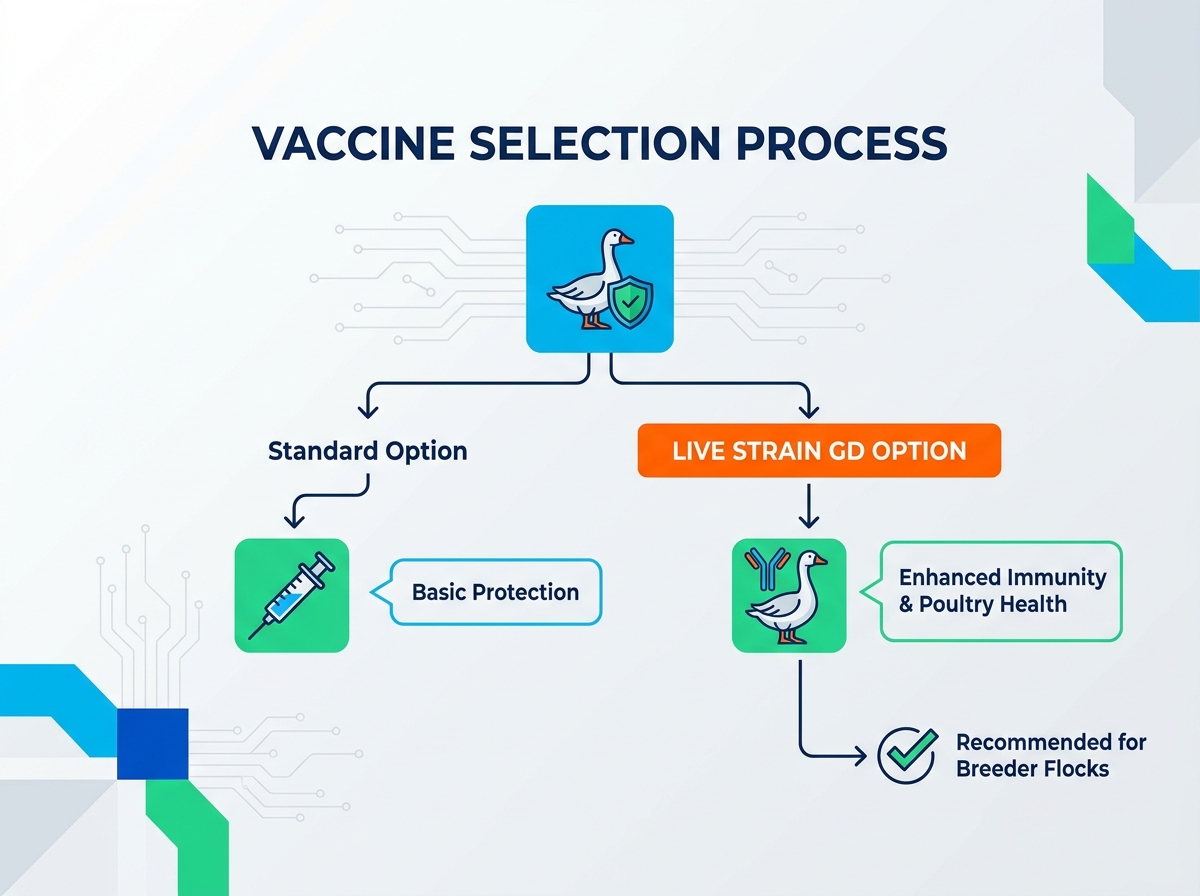
Live vaccines drive commercial gosling protection. They introduce a weakened virus that mimics natural infection, triggering rapid cellular and humoral immune responses. The bird produces memory B and T cells quickly, setting up a fast defense against field strains. This rapid onset is exactly what young birds need when moving from the clean hatchery to the contaminated grow-out barns.
When looking at commercial stock, the Gosling Plague Vaccine Live Strain GD and D strains deliver proven field results. Manufacturers attenuate the GD strain heavily so it does not revert to a virulent state, even after passing through multiple susceptible hosts. It forces rapid seroconversion. Commercial availability and consistent batch-to-batch titer levels make the GD strain a reliable choice for large-scale hatchery operations that cannot afford biological failures.
Field veterinarians often compare the GD strain to SYG and SYG61 lineages. SYG61 has a long track record, but many modern operations shift to the GD strain for its specific antigenicity and faster onset in early-age goslings. Despite these benefits, all live vaccines share a major flaw: maternal antibody interference. If you inject a live vaccine into a gosling carrying high maternal antibodies, those antibodies destroy the vaccine virus.
Inactivated formulas handle breeder maintenance. These use killed virus particles mixed with an adjuvant. You inject them into breeder flocks before the laying cycle starts. The hens build massive amounts of circulating antibodies and pack them into the egg yolks, passing passive immunity to the hatchlings.
To keep maternal antibody transfer high across a long breeding season, crews must inject inactivated boosters every three months. Inactivated vaccines take longer to build immunity, and the adjuvants can cause hard lumps at the injection site. However, they never revert to virulence, they do not cause clinical disease, and they bypass maternal antibody interference in older birds. You use inactivated vaccines to build the shield, and live vaccines to train the gosling's own immune system once that shield drops.
Researchers are testing chimeric ND-GP cVLPs (virus-like particles). These combine Newcastle Disease and Goose Parvovirus elements to offer the safety of a killed vaccine with the speed of a live one. While lab results look promising, commercial operators must stick to what is available in bulk. Traditional live and inactivated vaccines remain the only practical tools for large-scale flock management right now. Do not build a commercial health program around experimental biologicals that lack robust supply chains.
A gosling's baseline immunity depends entirely on the parent flock. A heavily vaccinated hen fills the yolk with immunoglobulins, protecting the gosling for weeks. Goslings from unvaccinated hens hatch with zero protection and catch the virus immediately. You cannot manage what you do not measure.
Hatchery managers must run serological tests to know exactly where they stand. Titer monitoring means pulling blood from a set percentage of the breeder flock to measure circulating antibodies. Without this data, scheduling shots is just guessing. Guessing leads to vaccine failure and dead birds.
Standard titer testing procedure:
Select a random sample of 5% of the active breeder flock across different pens to ensure an accurate cross-section.
Draw blood samples using sterile techniques to prevent cross-contamination between birds.
Process the serum and run ELISA or HI (Hemagglutination Inhibition) tests to quantify exact antibody levels.
Map the average titer score and calculate the expected half-life of maternal antibodies in the resulting eggs.
Adjust the hatchery vaccination schedule based on the projected day the maternal antibodies will drop below the interference threshold.
Farms running mixed waterfowl face overlapping viral threats. Goose parvovirus (GPV) and Muscovy duck parvovirus (MDPV) look similar in the field. Both cause severe enteritis, heart damage, and rapid death in young birds. However, they are virologically different. GPV hits geese hard and occasionally jumps to Muscovy ducks. MDPV strictly targets Muscovy ducks.
Because of this, you cannot just swap bottles. Buying duck vaccines and antibodies requires matching the exact viral strain to the species. Bivalent vaccines that cover both GPV and MDPV work well for mixed sites. Farm managers must audit their specific regional threats and buy the exact species-specific or bivalent formulas needed to prevent gaps in biosecurity.
Your vaccination program is only as good as the liquid in the bottle. Procurement teams must vet vendors aggressively. Look for Good Manufacturing Practice (GMP) certifications. Demand batch-to-batch consistency records and guaranteed minimum titer levels at the expiration date. Sourcing verified poultry health products ensures the biologicals perform in the barn exactly as they did in the lab.
The global market for these vaccines is expanding, pushing toward $70.5 million by 2034. This growth brings better products but tightens the supply chain during peak breeding seasons. Operations must lock in inventory early. Set up long-term contracts with suppliers to ensure you never run out of biologicals when the hatcheries are full. Relying on spot-market purchases during an outbreak guarantees you will pay a premium for whatever leftover stock is available.
Heat destroys live vaccines. The number one cause of vaccine failure is a temperature spike during shipping or storage. Live attenuated viruses degrade fast when exposed to heat or UV light.
You must maintain strict cold-chain storage at −15°C (5°F). Install digital monitors with automated alarms in all biological refrigerators. Rotate inventory using First-In, First-Out. Once you mix a live vaccine, keep it on ice and throw away anything left over after two hours.
Receiving protocol for biologicals:
Inspect the shipping cooler immediately upon arrival for physical damage or broken seals.
Check the internal temperature logger to verify the shipment stayed below 8°C in transit.
Transfer vials immediately to the dedicated biological refrigerator, ensuring they do not touch the cooling element where they might freeze.
Log the batch numbers, expiration dates, and receiving temperatures into the inventory management system.
Crews make mistakes. Injecting too deep into the muscle or missing the subcutaneous pocket causes the vaccine to leak or absorb poorly. Dirty needles introduce bacteria, causing abscesses or systemic sepsis. Using the wrong needle gauge damages tissue and stresses the bird.
Write and enforce strict Standard Operating Procedures (SOPs). Train crews hands-on for subcutaneous (base of the neck) and intramuscular (breast or thigh) injections. Show them exactly how to tent the skin at the neck to avoid hitting the spine. Calibrate automatic syringes every morning. Change needles every 50 to 100 birds to keep them sharp and clean.
Breakthroughs happen when environmental viral loads get too high or a variant field strain hits. Watch for lethargy, birds refusing feed, watery diarrhea, and goslings huddling with drooping wings. Early detection saves the rest of the barn.
Isolate the sick flock immediately to stop horizontal spread. Do not vaccinate sick birds; it will not work. Switch to reactive treatments. Inject hyperimmune serum or specific yolk antibodies to provide immediate passive immunity. This neutralizes the virus in the bloodstream, dropping the mortality rate and giving the birds time to recover while you decontaminate the surrounding pens.
To secure your commercial breeder flocks and ensure maximum progeny survival, execute the following steps immediately:
Draw blood samples from 5% of your active breeder flock this week to establish an accurate baseline of maternal antibody titers.
Schedule a consultation with your avian veterinarian to calculate the exact maternal antibody decay curve for your next hatch.
Audit all biological refrigerators on site and install digital temperature monitors with mobile alarm capabilities.
Rewrite your vaccination SOPs to mandate needle changes every 100 birds and daily calibration of all automatic syringes.
Secure procurement contracts for your required volume of the Gosling Plague Vaccine at least 60 days ahead of peak breeding season.
A: The optimal age depends entirely on maternal immunity levels. For goslings hatched from standard vaccinated flocks, administer the first dose between 7 to 10 days of age. If the parent flock was fully vaccinated and recently boosted, delay administration until 14 days of age. This delay prevents high levels of maternal antibodies from neutralizing the live vaccine before it triggers active immunity.
A: Breeder goose flocks require continuous immunological maintenance to protect their progeny. Inject inactivated vaccines at strict 3-month intervals throughout the active breeding season. This rigid schedule ensures the hens maintain peak circulating antibody levels, which maximizes the passive immunity transferred directly into the egg yolk.
A: The Live Strain GD is an attenuated virus that triggers rapid cellular and humoral immunity, providing fast protection for young goslings. Inactivated vaccines use killed viruses mixed with adjuvants. They have a slower onset but carry zero risk of reverting to virulence, making them the standard choice for boosting older breeder hens safely.
A: Yes, maternal antibody interference is a primary cause of vaccine failure in the field. If you inject a live attenuated vaccine while the gosling still carries high maternal antibodies, those antibodies will destroy the vaccine virus. The bird's immune system never reacts, leaving the gosling completely unprotected once maternal immunity fades.
A: No, they are not interchangeable. Goose parvovirus and Muscovy duck parvovirus cause similar clinical diseases but are virologically distinct. Mixed waterfowl operations must procure species-specific vaccines or specialized bivalent formulations to ensure comprehensive protection across different bird populations without leaving gaps in biosecurity.
A: Store live vaccines under strict cold chain conditions, continuously maintained at −15°C (5°F). Exposure to heat or direct UV light rapidly degrades the viral titer, rendering the vaccine useless. Once reconstituted, keep the vaccine on ice and discard any unused portion within two hours.


